
How AI Can Reduce Shipping Costs
Learn how AI reduces eCommerce shipping costs through dynamic courier selection, zone-aware rate optimization, RTO prediction, and automated rules.
The Cost Problem AI Solves
Shipping cost optimization is not simply finding the lowest freight quote per shipment. Total shipping economics include RTO freight on undelivered orders, COD handling fees, failed delivery reattempt costs, and operational labor for manual rate comparison and booking. AI reduces costs by optimizing across these factors simultaneously rather than minimizing one visible line item.
A human comparing rates in two courier portals before each booking captures cost on that moment's quote but misses historical RTO patterns, volumetric billing nuances, and lane-specific performance that affect total landed cost. AI systems incorporate these variables at decision time for every order.
This article focuses on cost reduction through AI. For general shipping cost tactics without AI, read how to reduce eCommerce shipping costs. For selection mechanics, see AI-powered courier selection.
Per-Order Rate Optimization Across Carriers
The most direct AI cost lever is multi-carrier rate comparison with intelligent selection. For each order, the system fetches rates from all serviceable carriers, applies volumetric weight rules correctly, includes COD fees, and selects the option that minimizes predicted total cost — optionally subject to delivery speed or success rate floors.
At scale, even small per-shipment savings compound. AI ensures the comparison happens on every order consistently, not only when staff remember to check during slow afternoon shifts.
Multi-courier shipping provides the infrastructure AI needs; without multiple carrier options, AI has nothing to optimize across.
Reducing RTO-Driven Cost Through Smarter Routing
RTO doubles freight expense and eliminates order revenue. AI models that incorporate historical RTO rate by carrier and pincode cluster avoid routing high-risk orders to carriers with poor performance on that lane — even when those carriers offer the lowest base rate.
The cost math is straightforward: if Carrier A saves 15 rupees on freight but RTO rate is 5 percentage points higher than Carrier B on a 800-rupee COD order, the expected cost of Carrier A's RTO risk often exceeds the freight saving. AI selection internalizes this calculation per order.
Pair AI routing with NDR automation for orders that still fail first attempt — cost optimization does not end at booking.
| Cost component | Without AI | With AI optimization |
|---|---|---|
| Base freight | Default carrier rate | Best rate among eligible carriers |
| COD fees | Often ignored in comparison | Included in total cost model |
| RTO risk | Not factored at booking | Weighted by lane history |
| Manual comparison labor | Staff time per order | Automated at booking |
| Volumetric billing errors | Inconsistent declarations | Catalog-driven weight data |
Operational Cost Reduction Through Automation
AI-driven automation reduces labor cost per shipment: automated booking, bulk label generation, NDR prioritization, and tracking sync eliminate portal-hopping that scales linearly with headcount. Shipping automation quantifies which workflows deliver the highest operational savings.
NDR prioritization AI ensures staff time focuses on recoverable high-value shipments first rather than processing NDR queues chronologically. Faster recovery means fewer RTO conversions and less return freight.
Anomaly detection on shipping spend alerts finance when a carrier's average cost per zone spikes — often the first sign of rate card changes, weight correction billing, or routing rule drift worth investigating before month-end reconciliation surprises.
When AI Cost Optimization Delivers Most Value
AI cost tools deliver strongest ROI when you ship sufficient volume across diverse pincodes with multiple carrier options and meaningful COD share. Single-carrier, single-zone operations with flat rate cards gain little from intelligent selection.
Merchants transitioning from manual booking to automated multi-courier with AI often see the largest step-change — not because AI is magic, but because consistent per-order optimization replaces inconsistent manual habits.
Logistics aggregators serving seller networks multiply AI value: each seller benefits from intelligent routing without hiring logistics analysts. ShipRabbit's platform targets this use case with white-label multi-courier booking and AI-assisted selection built in.
Setting cost vs quality trade-offs
Configure AI with explicit priorities rather than accepting default cheapest-carrier behavior. Pure cost minimization may increase RTO on borderline lanes. Define minimum delivery success thresholds or maximum transit days so AI optimizes cost within service quality guardrails your brand can accept.
Measuring AI Cost Impact
Track cost per delivered order weekly — total shipping spend divided by successfully delivered shipments, excluding RTO. Compare against pre-AI baseline over matched order volume and seasonality. Segment by zone to catch lanes where AI helps versus lanes where data was too sparse for reliable optimization.
Include operational savings: hours saved on manual booking and NDR processing, converted to cost per shipment using fully loaded labor rates. Total AI ROI combines freight savings and labor reduction minus platform fees.
Explore ShipRabbit's courier aggregator software, AI in eCommerce shipping, and aggregator pricing when building your business case.
Common Pitfalls in AI Cost Optimization
Optimizing exclusively for lowest freight quote ignores RTO cost on lanes where cheap carriers underperform. AI cost models must include expected RTO probability or they systematically assign high-risk orders to cheapest partners with poor delivery success.
Overfitting to historical data from an unusual period — festive season surge, single-carrier outage month — produces routing rules that fail when conditions normalize. Exclude anomalous periods from training data or weight recent months appropriately.
Ignoring operational constraints during optimization creates theoretically optimal assignments that warehouses cannot execute — wrong label format, missed pickup cutoff, carrier not integrated with your manifest process.
Failing to re-evaluate after catalog or geographic expansion leaves AI optimizing for yesterday's order mix while today's orders ship to new pincodes with no historical signal. Trigger model review when order geography or category mix shifts materially.
Combining AI with Manual Policy Levers
Some cost levers remain manual even with AI: negotiating rate cards with carriers, adjusting free shipping thresholds, changing packaging sizes, restricting COD on high-RTO segments. AI optimizes within the policy envelope leadership defines — it does not replace strategic pricing and catalog decisions.
Seasonal promotions may temporarily prioritize speed over cost to meet delivery promises in marketing campaigns. Configure temporary AI weight adjustments rather than rewriting core selection models for short promotional windows.
Platform economics for aggregators add another layer: per-shipment margin, seller subscription revenue, and carrier volume incentives. AI selection may optimize network-level economics differently than individual seller cost — configurable per seller tier on platforms like ShipRabbit.
Building the Business Case for AI Cost Tools
Quantify baseline cost per delivered order before AI deployment including freight, COD fees, RTO freight, and estimated manual labor hours for rate comparison and booking. Present AI ROI as improvement against this baseline rather than absolute savings claims.
Include soft benefits in the business case: faster dispatch cycles, fewer booking errors, reduced training time for new warehouse staff who no longer navigate multiple courier portals. Soft benefits are harder to quantify but real at scale.
Pilot scope should be large enough to measure statistically — typically several hundred orders per week on selected zones — but small enough to rollback quickly if outcomes degrade versus control group using existing rules.
Quick Wins Before Full AI Deployment
Even before AI deployment, automated multi-carrier rate comparison at booking captures much of the freight savings AI would optimize — ensure basic rate comparison is live first. Clean address validation at checkout reduces RTO that no routing AI can recover after the fact.
NDR automation delivers cost savings independent of AI selection by converting failed deliveries to successful ones. Prioritize exception automation alongside intelligent routing for compounding return on platform investment.
Key Takeaways
- AI selects the lowest-cost courier that meets delivery success thresholds per lane
- RTO prediction flags high-risk orders for verification before shipping, saving double freight
- Dynamic rate shopping beats static courier assignments as carrier pricing changes frequently
- Automated weight and dimension validation prevents costly volumetric weight surprises
- Combined AI optimizations typically reduce shipping spend 8-15% for mid-volume sellers
Frequently Asked Questions
How much can AI reduce shipping costs?
Sellers typically see 8-15% shipping cost reduction from AI courier selection alone, with additional savings from RTO prevention.
Does AI cost optimization sacrifice delivery speed?
Good AI models optimize within constraints you set — balancing cost against maximum transit time and minimum success rate per order.
Is AI cost optimization available on all aggregator platforms?
Not all platforms offer AI selection. ShipRabbit includes AI-assisted routing as a built-in feature for automated cost and performance optimization.
How does AI handle sudden courier rate changes?
Models incorporate real-time rate data and adjust recommendations immediately rather than waiting for manual rule updates.
ShipRabbit
See how ShipRabbit manages multiple courier partners from one dashboard
Reduce shipping costs, improve delivery success, and scale operations without switching between courier portals.
Related Articles
How to Reduce eCommerce Shipping Costs
Practical tactics to reduce eCommerce shipping costs — courier selection, zone optimization, packaging, COD conversion, and multi-carrier rate comparison.
Read article →AI-Powered Courier Selection Explained
How AI-powered courier selection works — data inputs, scoring models, pincode performance analysis, and automated routing that cuts costs and RTO.
Read article →AI in eCommerce Shipping
Explore how AI is transforming eCommerce shipping — smart courier selection, demand forecasting, NDR prediction, and automated logistics optimization.
Read article →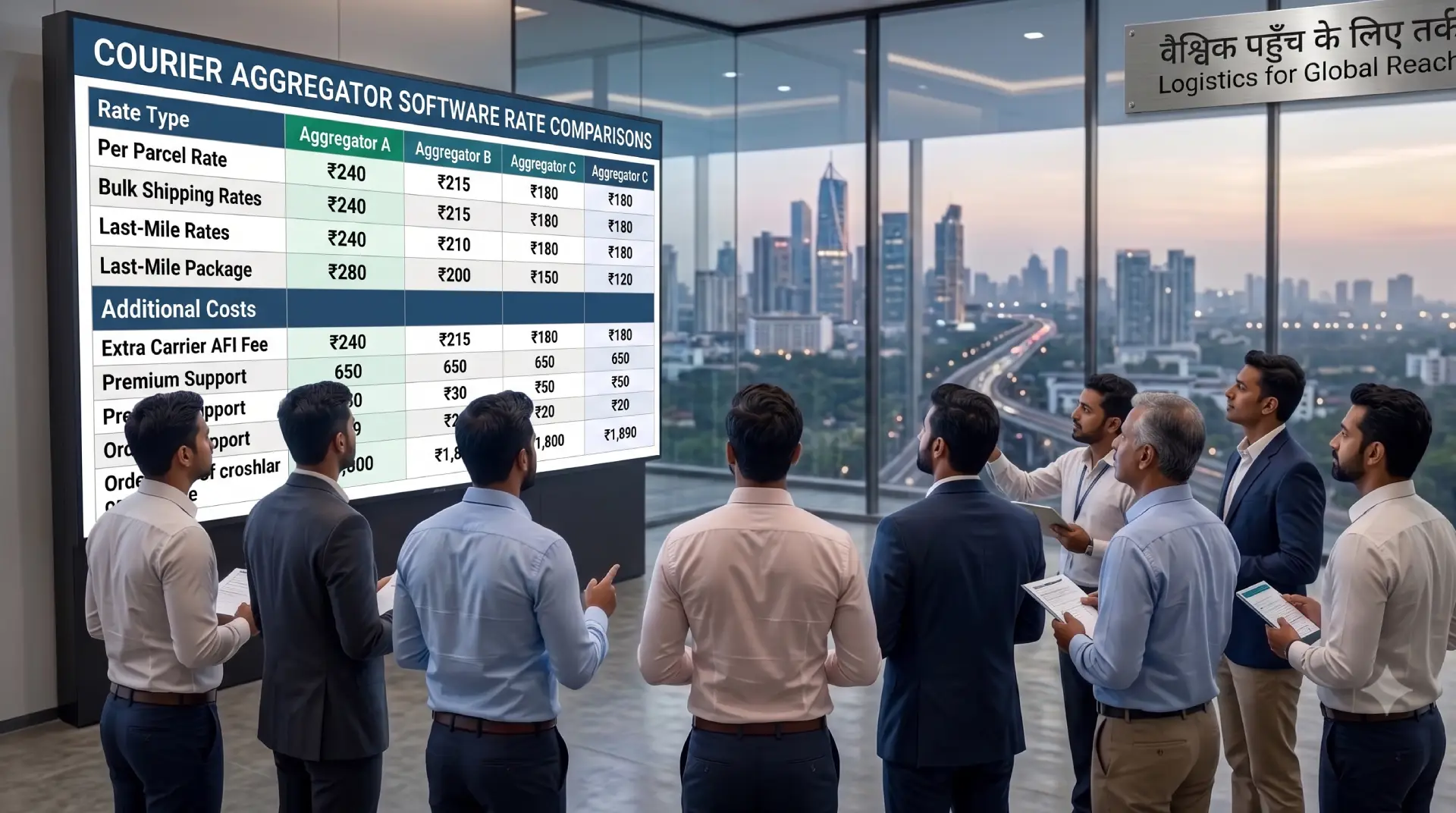
Courier Aggregator Software Pricing Explained
Understand courier aggregator software pricing models — per-shipment fees, subscriptions, wallet systems, and how to calculate total cost of ownership.
Read article →Stay ahead in eCommerce logistics
Get practical shipping guides, courier insights, and automation tips delivered to your inbox.