
Courier Aggregator Software for Online Sellers
How online sellers use courier aggregator software to compare rates, print bulk labels, automate tracking, and ship through multiple couriers efficiently.

The Online Seller Shipping Challenge
Online sellers — whether on marketplaces, social commerce, or independent stores — compete on price, delivery speed, and reliability. Shipping costs directly affect buy box performance, margin, and customer ratings. Courier aggregator software lets sellers access multiple carriers, compare rates, and automate fulfillment without enterprise logistics teams.
Seller workflows differ from D2C brand workflows: marketplace label rules, multi-channel order volumes, and tighter margin pressure shape feature priorities.
Read what courier aggregator software is and its benefits for background.
Marketplace vs Independent Store Requirements
Marketplace sellers must comply with channel-specific label formats, AWB upload timing, and tracking sync rules. Independent store sellers prioritize checkout integrations and branded communications.
Confirm your aggregator supports every channel you sell on — or provides API access to build custom sync. Missing channel support forces parallel manual processes that defeat aggregation value.
D2C brand guide complements this for owned-store-focused sellers.
| Seller type | Priority feature | Common pitfall |
|---|---|---|
| Amazon / Flipkart seller | Marketplace tracking sync | Late AWB upload penalties |
| Shopify merchant | Auto order import | Manual CSV exports |
| Multi-channel seller | Unified dashboard | Separate tools per channel |
| Social commerce | Fast mobile booking | No bulk label support |
Rate Comparison and Margin Protection
Online sellers often operate on thin margins. Per-order shipping savings from multi-carrier comparison directly protect profitability. Automate cheapest-eligible routing for standard SKUs; reserve manual selection for high-value or fragile items.
Reducing shipping costs and understanding pricing help model margin impact accurately.
Bulk Operations for High-Volume Days
Sale events spike order volume. Sellers need bulk order import, batch AWB generation, and batch label printing without API throttling or dashboard timeouts. Test peak-load behavior during vendor trials.
Pickup scheduling must handle sudden volume increases — confirm courier pickup SLAs and aggregator queue handling under load.
NDR and RTO: Seller-Specific Impact
Marketplaces penalize high cancellation and poor delivery metrics. NDR automation that contacts buyers before RTO protects seller account health, not just shipping cost.
NDR management and NDR workflows explain tools sellers should prioritize in demos.
COD Remittance for Marketplace and D2C Sellers
COD remains common for online sellers in many categories. Track remittance cycles across couriers in one wallet view. Delayed remittance affects restocking and ad spend — treat it as a financial feature, not back-office detail.
What COD remittance is clarifies settlement stages to verify with vendors.
When Sellers Become Logistics Operators
Some sellers evolve into fulfillment services for other merchants. That transition requires white-label seller portals, downstream billing, and configurable rate cards — merchant dashboards are insufficient.
ShipRabbit provides white-label infrastructure for this pivot. See white-label guide and starting an aggregation business.
Getting Started as an Online Seller
Map channels, volume, COD share, and top pincodes. Trial platforms with last week's orders. Involve whoever prints labels daily.
Use selection checklist and best eCommerce aggregators framework. Visit ShipRabbit if building a seller network rather than shipping only your inventory.
Festive Season and Sale Event Preparation
Online sellers face order spikes during Diwali, Republic Day sales, and marketplace-wide events. Pre-configure routing rules before peaks so temporary staff or extended shifts do not manually select couriers under time pressure.
Confirm wallet balance alerts and pickup capacity with both aggregator support and courier partners one week before major campaigns. Late AWB generation during peaks triggers marketplace penalties and buyer complaints simultaneously.
Post-event review carrier performance data to adjust default routing before the next sale — partners that lag during load often recover or degrade further depending on hub capacity.
Multi-Channel Order Consolidation
Sellers on Amazon, Flipkart, Meesho, and own stores historically juggled separate shipping workflows per channel. Modern aggregators consolidate into one dispatch queue with channel tags — print all labels in one session regardless of source.
Confirm each channel's AWB upload deadline and tracking sync requirements during vendor evaluation. Missing marketplace SLAs hurts account health more than small shipping rate differences.
Competitive Pressure on Shipping Economics
Marketplace algorithms factor shipping speed and reliability into visibility. Online sellers cannot treat logistics as pure cost minimization if delivery metrics slip. Balance cheapest routing with carriers meeting channel performance thresholds.
Track shipping cost per channel separately — social commerce impulse purchases may tolerate higher shipping subsidy than marketplace price-war SKUs.
Inventory-Linked Shipping Considerations
Multi-warehouse sellers need origin-aware routing — same destination pincode may ship from Delhi or Bangalore with different courier options and costs. Confirm platform supports multiple pickup locations with correct zone calculation per warehouse.
Split shipments and partial fulfillments should not break tracking sync back to channels — test these edge cases in trial.
Support Playbooks for Seller Operations
Document internal SOPs: who handles NDR escalation, who approves courier switches for problem pincodes, who reconciles COD weekly. Software enables workflow; playbooks ensure consistency when staff change.
Use NDR workflow guide to build SOPs before peak season.
Seller Account Health on Marketplaces
Marketplaces track late dispatch, tracking upload delays, and buyer shipping complaints. Aggregator automation reducing manual AWB entry directly protects seller metrics affecting buy box and account standing.
Maintain buffer time in SLAs — if marketplace requires dispatch in 24 hours, target 18 internally to absorb aggregator or courier API latency during peaks.
Wholesale and B2B Order Exceptions
Online sellers occasionally ship bulk B2B orders outside standard eCommerce parcel rules. Confirm whether your aggregator supports heavier weight slabs, multiple boxes per order, and alternate payment terms before accepting B2B contracts.
Document exception handling outside platform automation — some orders may still need manual courier booking.
Daily Operations Rhythm for Marketplace Sellers
Typical high-volume seller rhythm: morning order sync from channels, mid-morning pack and bulk label print, afternoon pickup confirmation, evening tracking exception review. Aggregator dashboards should support this cadence without forcing repeated logins throughout the day.
Mobile-friendly booking or exception handling helps sellers managing operations away from desktop — verify mobile UX if your team dispatches from warehouse floor tablets or phones.
Transitioning From Courier-Specific Accounts
When migrating from direct courier accounts, run both systems briefly until in-flight AWBs complete delivery. Export historical performance data before losing access — useful for comparing pre and post aggregation outcomes objectively.
Scaling Seller Operations With Confidence
Online sellers scaling past manual shipping need reliable bulk tools, channel sync, and exception automation before hiring additional dispatch staff. The right aggregator pays for itself in labor savings and RTO reduction when adopted fully across warehouse and support teams.
Review aggregation benefits, selection criteria, and ShipRabbit if your seller business evolves into a logistics service for other merchants.
Key Takeaways
Online sellers — marketplace and multi-channel — need bulk labels, rate comparison, channel tracking sync, and NDR tools protecting account health and margin.
Confirm marketplace AWB and tracking requirements during vendor trials; missing channel support negates aggregation benefits for channel-heavy sellers.
Use selection checklist and pricing guide alongside feature evaluation during vendor comparison.
Run parallel workflows during migration until in-flight shipments on legacy courier accounts complete delivery and remittance cycles.
Schedule weekly courier performance reviews using platform reports — online sellers on tight margins benefit from data-driven routing adjustments more than occasional manual rate shopping.
Key Takeaways
- Marketplace sellers need fast label generation to meet dispatch SLAs
- Bulk AWB creation saves hours compared to booking shipments one by one
- Automatic tracking sync back to Amazon, Flipkart, and Shopify reduces penalties
- Rate shopping per order lowers shipping cost without renegotiating contracts
- One wallet balance replaces managing prepaid accounts with multiple couriers
Frequently Asked Questions
Can online sellers use aggregator software for marketplace orders?
Yes. Integrations sync orders from marketplaces, generate labels, and push tracking numbers back to meet dispatch deadlines.
How does bulk label printing work?
Select multiple orders, choose courier assignment rules or manual selection, and print all labels in one batch from a single dashboard.
Do aggregators support both prepaid and COD orders?
Most platforms support both payment modes across their courier partner network, though COD availability varies by pincode.
Is aggregator software suitable for small online sellers?
Yes. Even sellers doing 20-30 daily orders benefit from unified tracking and not logging into multiple courier portals.
ShipRabbit
See how ShipRabbit manages multiple courier partners from one dashboard
Reduce shipping costs, improve delivery success, and scale operations without switching between courier portals.
Part of our Courier Aggregator Software guide series — explore the complete resource for multi-courier shipping and aggregation.
Related Articles
Courier Aggregator Software for D2C Brands
How D2C brands use courier aggregator software for branded tracking, multi-zone delivery, COD management, and a consistent post-purchase experience.
Read article →
Best Courier Aggregator Software for eCommerce
A buyers guide to the best courier aggregator software for eCommerce — key features, courier coverage, pricing, and what to look for when evaluating platforms.
Read article →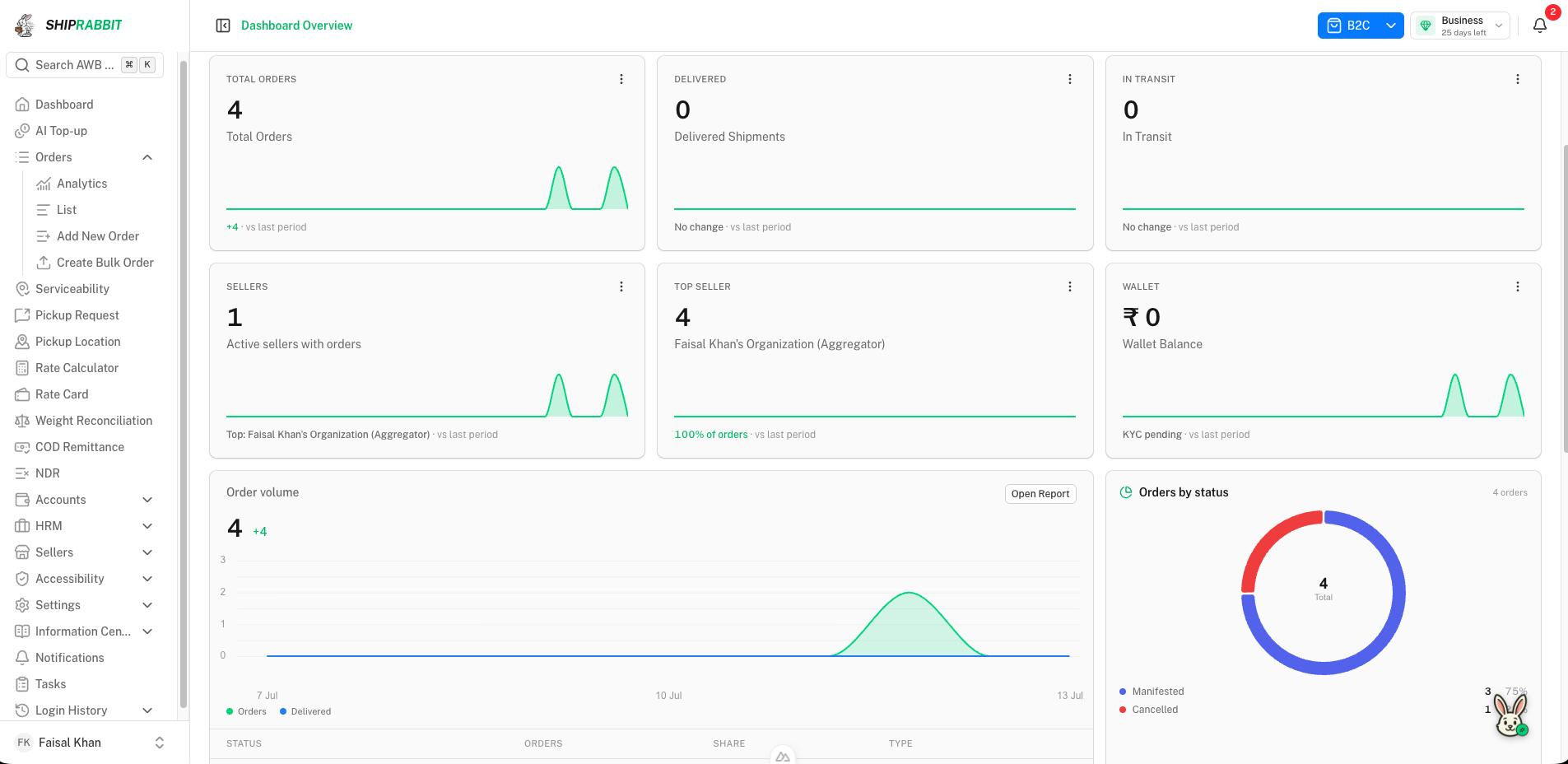
Shipping Automation for eCommerce Businesses
How shipping automation helps eCommerce businesses scale — auto label generation, tracking sync, NDR workflows, courier rules, and API integrations.
Read article →How to Reduce eCommerce Shipping Costs
Practical tactics to reduce eCommerce shipping costs — courier selection, zone optimization, packaging, COD conversion, and multi-carrier rate comparison.
Read article →Stay ahead in eCommerce logistics
Get practical shipping guides, courier insights, and automation tips delivered to your inbox.